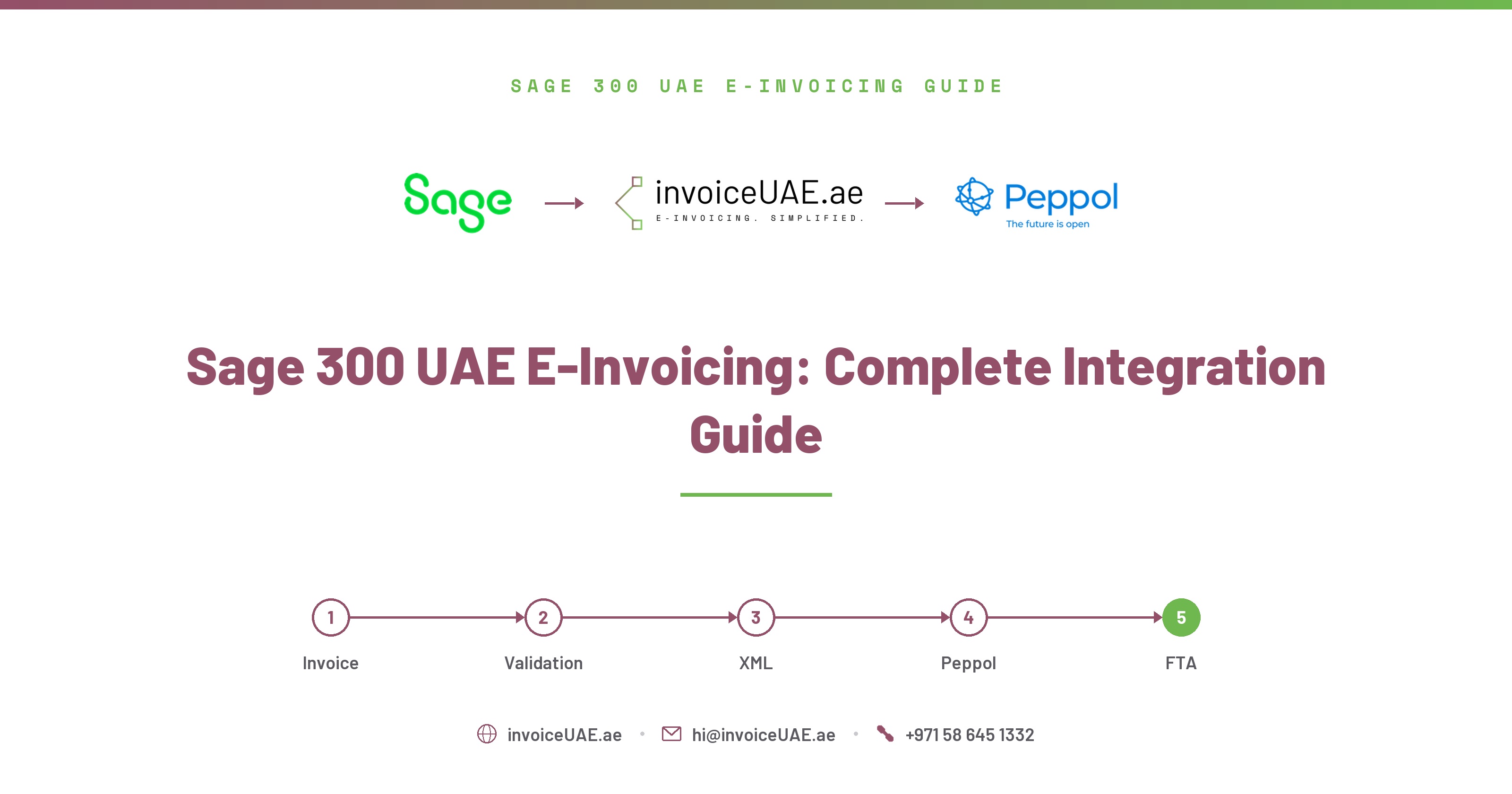
How to connect Sage 300 to the UAE Peppol network without replacing your ERP — field mapping, ASP submission, and compliance deadlines explained.
Sage 300 does not natively generate UAE Peppol PINT-AE XML or connect to FTA-approved ASPs. UAE VAT-registered businesses running Sage 300 need a middleware connector to bridge between their Sage 300 data and the UAE Peppol network. InvoiceUAE provides this connector via Sage 300's Web Services REST API, or CSV/XML/JSON export — without requiring you to replace or modify Sage 300 itself.
InvoiceUAE is built by Infotree Computers LLC, a Dubai-based technology firm that has been implementing QuickBooks, Sage 50, Sage 300, Zoho One and Zoho Books for UAE and GCC businesses for 14 years. Infotree is a Certified QuickBooks ProAdvisor, Authorized Zoho Partner, Authorized Sage Partner, and holds Odoo Gold Partner status at the Gold level through an affiliate partnership. The team operates from offices in Dubai (UAE), Saudi Arabia, and Bhubaneswar (India), and InvoiceUAE's ASP partner is TaxStar (FTA-approved).
UAE e-invoicing is the Federal Tax Authority's mandatory framework requiring VAT-registered businesses to exchange B2B and B2G invoices as structured Peppol PINT-AE XML through an Accredited Service Provider, instead of a PDF. It runs alongside VAT return filing as a separate, parallel compliance obligation.
For the full picture in one place — legal framework, timeline, penalties, and software comparison — see our complete UAE e-invoicing guide. For a plain-English introduction, see what UAE e-invoicing means for your business.
No. Sage 300 (formerly Accpac) is a capable mid-market ERP widely used by UAE businesses in trading, distribution, manufacturing, and professional services. It handles accounting, purchasing, inventory, and reporting well. What it cannot do is generate PINT-AE structured XML invoices or transmit them to an FTA-approved Accredited Service Provider through the UAE Peppol network.
This is not a Sage 300 limitation specific to the UAE — PINT-AE is a government-mandated technical standard that virtually no accounting or ERP software supports out of the box without a purpose-built integration layer. Sage 300 is not an ASP and isn't trying to be one; the gap is the e-invoicing transmission layer, not Sage 300's accounting fundamentals, which remain solid.
Sage 300 stores a lot of invoice information, but UAE PINT-AE requires 51 mandatory fields for a tax invoice and 49 for a commercial invoice. Several of these are simply not present in a standard Sage 300 invoice record:
InvoiceUAE's field mapping handles this enrichment systematically. UAE-specific fields are configured once per customer and per product/service, and apply automatically to every invoice pulled from Sage 300 going forward.
| Requirement | Sage 300 (Native) | With InvoiceUAE |
|---|---|---|
| Peppol PINT-AE XML generation (UBL 2.1 + SBDH) | Not available | Auto-generated per invoice |
| UAE VAT tax groups | Percentage-based, not PINT-AE coded | Mapped to S/Z/E/AE category codes |
| Peppol Participant / Endpoint ID (scheme 0235 + TIN) | Not a native field | Captured once per customer, applied automatically |
| Direct submission to an FTA-approved ASP | Not possible from within Sage 300 | Supported for any ASP on the Ministry of Finance's pre-approved list |
| Per-invoice submission status (accepted/rejected) | Not tracked | Returned from the ASP and visible in InvoiceUAE's audit trail |
InvoiceUAE's Sage 300 connector authenticates against Sage 300's own API and reads sales invoice records directly — it doesn't create, edit, or delete anything inside Sage 300 itself.
If your Sage 300 deployment uses Sage 300 Web Services or a recent version with REST API support, InvoiceUAE connects directly. Invoices are pulled on a scheduled basis — typically every 30 minutes — without any manual export step.
For on-premise Sage 300 installations or versions without REST API support, InvoiceUAE accepts structured CSV, XML, or JSON exports from Sage 300's invoice reports. Your team runs a standard export on a daily or weekly basis, uploads it to InvoiceUAE, and the rest is automated.
Not sure how to choose an ASP for your business? See our ASP selection guide and our complete ASP explainer — both link to the Ministry of Finance's official pre-approved provider list.
Read the ASP Guide →Total implementation timeline for a typical Sage 300 mid-market business: 4 to 8 weeks, with the bulk of that time on master data remediation rather than technical setup.
Sage 300 already models credit notes as a distinct transaction type from a standard invoice — InvoiceUAE reads this distinction directly rather than inferring it from a negative amount. Each credit note is transmitted as Peppol document type 381, referencing the original invoice it corrects, which keeps your FTA audit trail and VAT return figures consistent. Under UAE VAT Law Article 62, credit notes generally need to be issued within 14 days of the adjustment being identified.
| Phase | Business Criteria | ASP Appointment Deadline | Mandatory Go-Live |
|---|---|---|---|
| Phase 1 | Revenue ≥ AED 50 million | 30 October 2026 | 1 January 2027 |
| Phase 2 | Revenue < AED 50 million | 31 March 2027 | 1 July 2027 |
Mid-market Sage 300 businesses typically handle higher invoice volumes than smaller QuickBooks users, meaning more data complexity — customer master remediation, multiple entities, multi-currency invoices — and more runway needed. See our UAE E-Invoicing Mandate guide for the full breakdown.
For the full list with detailed fixes, see our Setup Mistakes & Best Practices guide.
Not sure if your accounting system is ready for UAE e-invoicing? Contact Infotree for a GAP Analysis and System Impact Assessment — we'll map exactly where your Sage 300 setup stands against PINT-AE requirements before your ASP deadline. Have other accounting-related issues or e-invoicing compliance questions? Contact us — we're happy to help.
Request a Free GAP Analysis →Need hands-on help? Contact Infotree for Sage 300 e-invoicing implementation — from ASP selection to go-live testing, our team handles the full setup.
Contact Us for Sage 300 Implementation →The current UAE mandate covers B2B and B2G transactions between VAT-registered businesses. B2C invoices to end consumers are not currently in scope. Export invoices must be reported to the FTA but are not transmitted to buyer ASPs via Peppol. InvoiceUAE filters transaction types automatically based on your supply type configuration.
Historical invoices issued before your mandatory go-live date are not required to be re-submitted through the Peppol network. The mandate applies to invoices issued on or after your mandatory date.
No. InvoiceUAE reads data from Sage 300 via its Web Services REST API or CSV/XML/JSON export. It does not write back to Sage 300, modify your company file, or require any Sage 300 add-on installation.
Yes. InvoiceUAE's multi-company module allows accounting firms and businesses with multiple UAE entities to manage all companies from one account, each with its own ASP connection, customer master, and submission history.
The same phased mandate that applies to every VAT-registered UAE business. Phase 1 (revenue ≥ AED 50 million): ASP appointment by 30 October 2026, go-live by 1 January 2027. Phase 2 (all other VAT-registered businesses): ASP appointment by 31 March 2027, go-live by 1 July 2027.
Ready to connect Sage 300 to UAE Peppol e-invoicing?
Start Your Free 15-Day Trial →Sources: UAE Ministry of Finance — Cabinet Decision No. 106 of 2025, Ministry of Finance — Pre-Approved Service Providers.

Ashish Singh is a UAE E-Invoicing specialist and Software Consultant at Infotree Computers LLC, Dubai — a firm with 14 years of QuickBooks implementation experience across the UAE and GCC, and Odoo Gold Partner status through an affiliate partnership. A QuickBooks ProAdvisor (Silver) with hands-on expertise across Zoho, QuickBooks, Odoo, Xero, and Sage, he specializes in Peppol PINT-AE compliance and ERP-to-ASP integration for businesses across the UAE and Middle East.