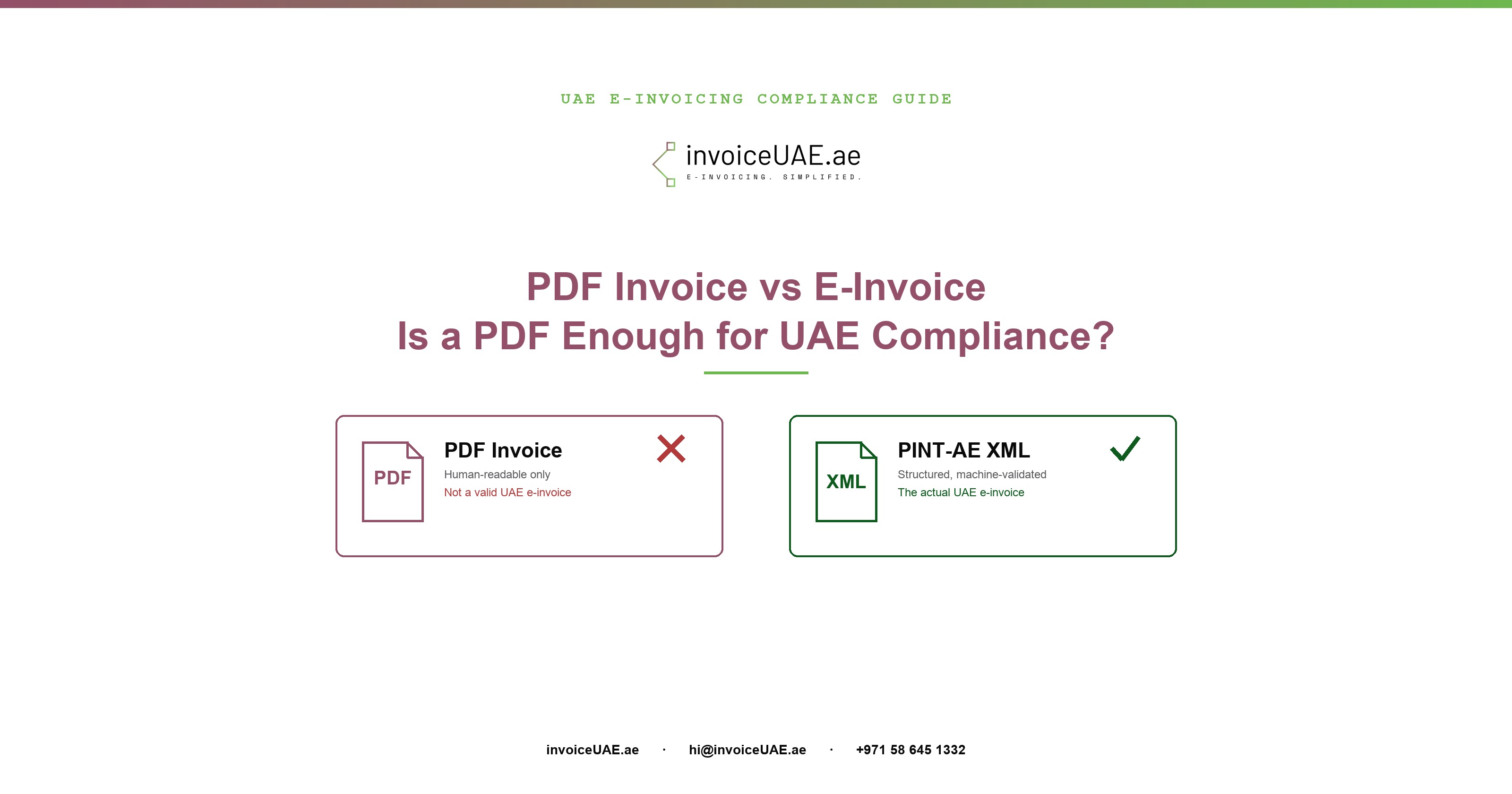
A question a lot of UAE businesses get wrong — answered directly. Emailing a PDF invoice is not the same as UAE e-invoicing. Here is the real difference, why the confusion exists, and what you actually need to be compliant before January 2027.
A PDF is a human-readable document, not structured data. The UAE Federal Tax Authority requires B2B and B2G invoices to be generated in PINT-AE XML format and submitted through an FTA-approved Accredited Service Provider (ASP) over the Peppol network. Emailing a PDF — however professional it looks, even with a TRN and VAT breakdown on it — does not meet this requirement on its own.
InvoiceUAE is built by Infotree Computers LLC, a Dubai-based technology firm that has been implementing QuickBooks, Sage 50, Sage 300, Zoho One and Zoho Books for UAE and GCC businesses for 14 years. Infotree is a Certified QuickBooks ProAdvisor, Authorized Zoho Partner, Authorized Sage Partner, and holds Odoo Gold Partner status at the Gold level through an affiliate partnership. The team operates from offices in Dubai (UAE), Saudi Arabia, and Bhubaneswar (India), and InvoiceUAE's ASP partner is TaxStar (FTA-approved).
The confusion is understandable. For years, "sending an electronic invoice" has meant exactly one thing to most businesses: generating a PDF and emailing it instead of printing and posting a paper copy. That practice is genuinely called e-billing, and it has no specific compliance requirement attached to it.
The UAE's new mandate uses the term "e-invoicing" in a much stricter, technical sense — it does not mean "any digital file sent electronically." It means structured, machine-readable invoice data that an Accredited Service Provider validates and exchanges automatically with the buyer's system, with no PDF or human reading step required at all.
| Property | PDF Invoice | UAE E-Invoice (PINT-AE XML) |
|---|---|---|
| Designed for | A person to read | A system to read and validate automatically |
| Data structure | Fixed visual layout, no defined fields | Structured XML fields (TRNs, tax categories, emirate codes, line items) |
| Validated by an ASP | No | Yes — required before exchange |
| Transmission | Email, download, print | Peppol 5-corner network via ASP |
| Machine-processable | No (without separate OCR/parsing) | Yes, by design |
| Counts toward FTA compliance | No | Yes |
| Still useful for | Customer-facing readable copy, internal records | The legal invoice itself for B2B/B2G |
Here is the complete picture of what the UAE FTA mandates — and what a PDF simply cannot provide on its own:
Invoices must be generated in the UAE-specific PINT-AE XML schema based on UBL 2.1. A PDF rendering of the same invoice does not satisfy the mandate.
Every B2B and B2G invoice must be submitted through an Accredited Service Provider. Businesses must formally appoint one before their deadline.
Your 15-digit UAE Tax Registration Number must appear as a structured field in the PINT-AE XML — not just printed as text on a PDF.
For Business-to-Business invoices, the buyer's TRN must be included as a structured field. This is the #1 missing field causing ASP rejections.
Both seller and buyer addresses must include a UAE emirate code (e.g., AE-DU for Dubai, AE-AZ for Abu Dhabi) as structured data.
Every invoice line must carry a PINT-AE tax category: S (Standard 5%), Z (Zero-rated), E (Exempt), or O (Out of scope).
You may still generate and send a human-readable PDF alongside the PINT-AE XML, for the customer's own records. It carries no compliance weight.
May be added voluntarily to a PDF for customer convenience. Has no effect on compliance status — see our QR code guide for the full explanation.
Yes — and for most businesses, you probably should keep doing it. A readable PDF is still useful for:
The important shift is in what counts as the invoice for compliance purposes. For in-scope B2B and B2G transactions, the PINT-AE XML submitted through your ASP is the legal invoice. Any PDF you also send is a courtesy copy, not a substitute.
This is one of the more common and costly misunderstandings seen in UAE e-invoicing readiness conversations. A business that has emailed professional PDF invoices for years can reasonably (but wrongly) assume they're already most of the way to compliant. In reality, none of that PDF workflow satisfies the FTA mandate — the requirement is structural (XML format + ASP submission + Peppol exchange), not about how polished or complete the invoice document looks.
The penalty for non-compliance under Cabinet Decision No. 106 of 2025 is real: AED 5,000 per month for not appointing an ASP by your deadline, AED 100 per invoice (capped at AED 5,000/month) for invoices not issued through the mandated process, and AED 1,000 per day for malfunction-reporting failures.
The path to genuine FTA compliance is straightforward — and your existing PDF workflow can stay in place alongside it:
InvoiceUAE handles PINT-AE XML generation, TRN enrichment, ASP submission, and FTA reporting — automatically, from the accounting software you already use. Book a free demo to see exactly how it works.
Book a Demo →Not sure if your current invoicing process is compliant? Contact Infotree for a GAP Analysis and System Impact Assessment — we'll map exactly where your PDF/manual process stands against PINT-AE requirements before your ASP deadline. Have other accounting-related issues or e-invoicing compliance questions? Contact us — we're happy to help.
Request a Free GAP Analysis →Need hands-on help? Contact Infotree for UAE e-invoicing implementation — from ASP selection to go-live testing, our team handles the full setup, whichever accounting system or ERP you run.
Contact Us for E-Invoicing Implementation →No. A PDF is a human-readable document, not structured data. The UAE FTA mandate requires invoices in PINT-AE XML format submitted through an FTA-approved ASP over Peppol. A PDF does not meet this requirement on its own, however complete or professional it looks.
Yes, as a courtesy copy for your customer to read, print, or file. But the PDF carries no compliance weight by itself — the PINT-AE XML submitted through your ASP is what the FTA recognizes as the actual invoice for in-scope B2B and B2G transactions.
A PDF is a fixed, visual layout for a person to read — it can't be automatically validated or processed by another system. A UAE e-invoice is structured PINT-AE XML data with defined fields that an ASP validates and exchanges with the buyer's system over Peppol. The XML is the legal invoice; a PDF is just a readable view of it.
You would be non-compliant, with penalties under Cabinet Decision No. 106 of 2025: AED 5,000/month for no ASP, AED 100/invoice (capped at AED 5,000/month) for non-compliant invoices, and AED 1,000/day for malfunction-reporting failures.
No. Compliance is about the invoice format and transmission method — PINT-AE XML via an ASP over Peppol — not about adding features to a PDF. See our QR code guide for the full explanation of that specific misconception.
No. E-billing typically means sending an invoice electronically (email, PDF, portal) — common practice for years, with no specific FTA mandate. UAE e-invoicing refers specifically to the structured PINT-AE XML mandate via Peppol ASP, the new regulatory requirement phased in from 2026–2027.

Ashish Singh is a UAE E-Invoicing specialist and Software Consultant at Infotree Computers LLC, Dubai, with 5+ years helping SMEs and enterprises implement FTA-compliant workflows. A QuickBooks ProAdvisor (Silver) with hands-on expertise across Zoho, QuickBooks, Odoo, Xero, and Sage, he specializes in Peppol PINT-AE compliance and ERP-to-ASP integration for businesses across the UAE and Middle East.